

Why electrification is the key to the AI race
By Abdul Goni (Executive MBA 2025)
When we talk about the AI revolution, we tend to imagine data centres in Silicon Valley, Singapore or Frankfurt. We picture uninterrupted power, dense fibre networks and the infrastructure needed to support a digital economy at scale.
What we rarely picture is a hospital in Lagos running on diesel generators for most of the day, or a business in Accra losing productivity every time the grid fails. Yet these realities are directly connected. If Africa cannot secure reliable, affordable electricity, it will struggle to participate meaningfully in the next wave of global digital growth. As a private markets professional and Executive MBA candidate at Cambridge Judge Business School, I have been thinking deeply about how infrastructure investment, specifically institutional capital channelled through private infrastructure funds, can help close this gap. The opportunity is real, the returns are compelling and the stakes for the continent could not be higher.
The energy gap is the bottleneck
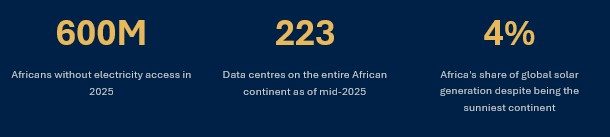
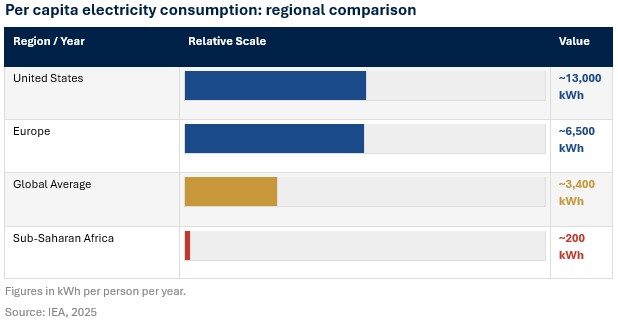
Africa’s electricity gap remains one of the continent’s biggest structural constraints. Reliable power is the foundation for industrial growth, digital infrastructure and ultimately long-term competitiveness. Without it, even the most promising sectors remain underdeveloped. That is why the AI conversation matters here. AI, cloud computing and data infrastructure all depend on stable electricity. Power is not a side issue, but an enabling layer. According to the International Energy Agency (IEA), nearly 2 out of 5 people in Africa still live without access to electricity. Fewer than 19 million people gained access in both 2023 and 2024, down from 23 million in 2019. Africa’s per capita electricity consumption stands at roughly 200 kilowatt hours per person per year, which is 65 times lower than the United States and 32 times lower than Europe. Building the kind of digital infrastructure that AI demands requires more than 4 hours of reliable power per day, which is the current state of access to electricity in most African countries.
The renewable energy imperative
Africa is the sunniest continent on earth, and yet its share of global solar generation stands at just 4%. Private sector clean energy investment has grown rapidly, from around $17 billion in 2019 to nearly $40 billion in 2024, more than doubling in 5 years. Solar now represents the least cost source of new power generation in many African countries. The technology has matured, the economics have shifted, what’s missing is structured institutional capital deployed at the right scale through the right vehicles.
Infrastructure funds as the best fit investment vehicle for Africa
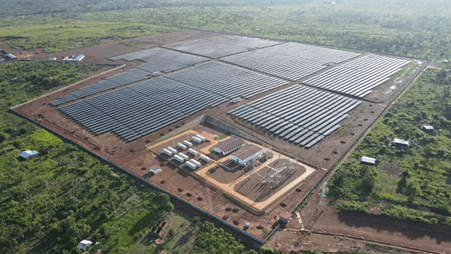
Private infrastructure funds are well suited to address Africa’s energy challenge. Unlike development grants or government programmes, infrastructure funds are designed to generate returns, which demands revenue visibility, and they can recycle capital into successive investments. The best structured funds combine institutional equity with concessional finance from development finance institutions (DFIs) such as British International Investment, IFC, DEG and Proparco, creating blended capital structures that reduce the cost of capital and improve bankability for projects that would otherwise struggle to attract purely commercial investors. The sweet spot for first generation infrastructure funds targeting Africa lies in the $10 million to 20 million per asset range. In Sub Saharan Africa, CAPEX benchmarks of around $6,824 per kilowatt peak are sizeable enough to generate meaningful returns while remaining below the threshold where the largest infrastructure managers compete.
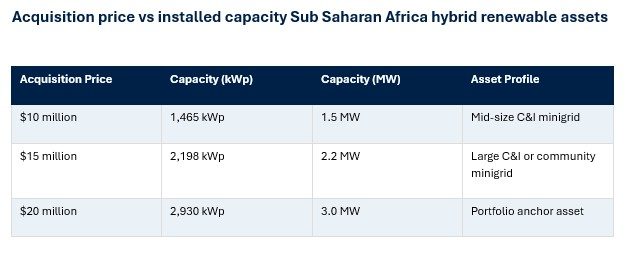
The revenue generation pipeline for infrastructure funds in Africa
The commercial and industrial sector (C&I) in most African countries serves as both anchor customer and proof of concept for revenue generation. Telecoms tower operators, manufacturing facilities, hospitals, universities, retail chains and cold storage providers across the continent are paying extraordinary sums for diesel power today. They are reliable, credit worth counterparties who actively want to replace their diesel dependency with long term power purchase agreements from independent power producers, which is an opportunity solar infrastructure can service at almost half the cost of diesel generators and reducing emissions simultaneously. A manufacturing facility in Lagos, for example, pays around $0.40 per kWh for diesel generation. A solar hybrid power source would cost between $0.25 to $0.30 per kWh through a long term agreement, which saves money and reduces emissions.
Another strategy for infrastructure funds is to have a joint venture with local renewable infrastructure developers based on a convertible debt structure to finance the development of the infrastructure, and convert to an equity stake upon completion of the project. A plain vanilla debt financing structure could also be a possible avenue to protect investor capital and guarantee returns.
The road ahead
Africa’s electricity demand is projected to grow by 5% in 2025 alone, which is more than double the rate seen in 2023 and exceeding the 4% global average. The African Union has set a target of 300 gigawatts of renewable capacity by 2030. The gap between ambition and execution is where private infrastructure capital can play its most important role.
The AI revolution will not wait for Africa to catch up on its own timeline; data centres need power today, and cloud computing expansion across the continent depends on reliable electricity. The window for Africa to position itself as a participant in the global digital economy is now. Infrastructure funds that move decisively, structure deals properly and build diversified portfolios of renewable energy assets across Africa are helping to build the electricity foundation without which no amount of digital ambition on the continent can be realised. In my personal opinion, this is what impact investing in its most compelling form looks like, and I am rooting for Africa to play its part in the digital future of the world.
What my Executive MBA at Cambridge has taught me about this opportunity
One of the most valuable things about studying at Cambridge Judge Business School is the way the programme challenges you to think about value creation at a systems level, not just the financial return of a single investment, but the broader economic architecture that determines whether markets function at all. In the context of African infrastructure, that means recognising that the energy gap is not a market failure in the traditional sense, but an opportunity for patient and structured capital to act as a catalyst for Africa’s digital future. During the course of my Executive MBA, I have learnt how to analyse assets, forecast returns on investments, efficiently identify bottlenecks in supply chains and assess risk and how to apply mitigants to ensure operational efficiency across all industries. I look forward to learning more valuable tools that will help me play a part in the electrification of Africa to play its part in the AI race.

Leave a Reply