

By Cambridge Executive MBA 2025 participants Robyn Baker, Caitlin Hafer, Stefan Pretterhofer and Eva Zhu (all members of Clare Hall)
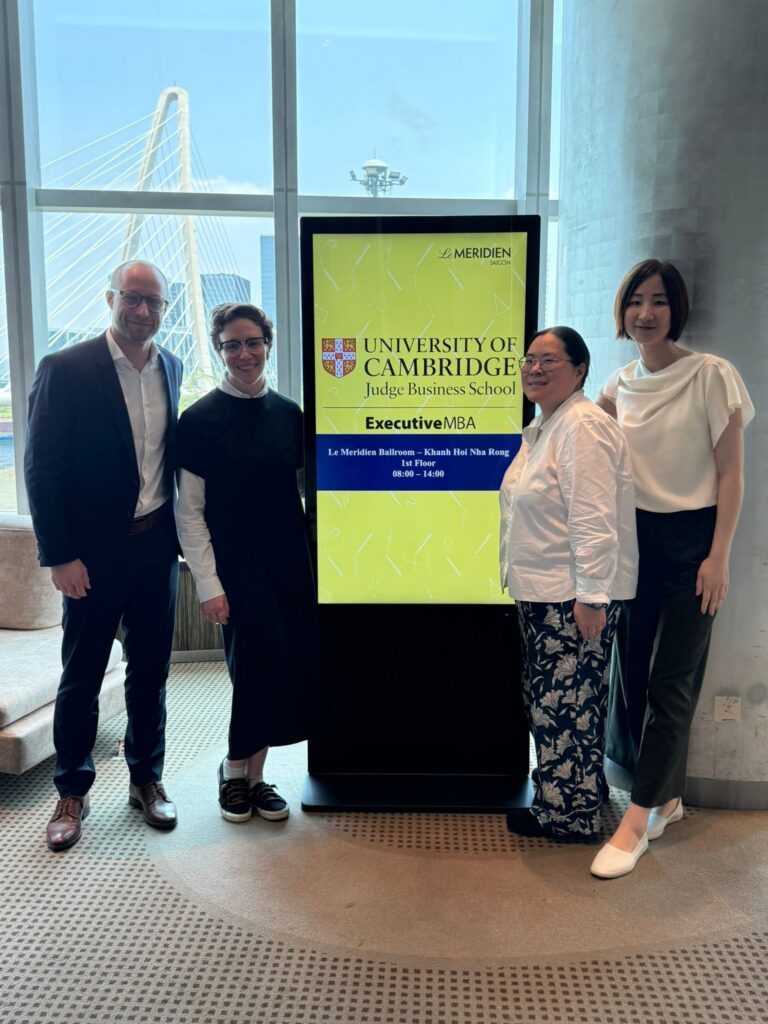
What better illustrates the complexity of international business than moving 75 members of your Executive MBA cohort from 4 continents to Ho Chi Minh City, Vietnam, less than 4 weeks after the start of the most recent Middle East conflict? After flight cancellations, agonising waits and frantic meetings, 63 of us arrived on hastily rebooked flights with last-minute visas in hand. This blog post is dedicated to our colleagues who are always with us in spirit but did not make the trip with us for a variety of reasons.
The International Business Study Trip is a highlight of Cambridge Judge’s Executive MBA programme. Led by Professors Michael Kitson and Christopher Marquis, we met a range of companies and local entrepreneurs, debated de-globalisation and institutional theory, and still had time for some sightseeing, street food and, of course, karaoke. Academically, it was an introduction to institutional theory, a framework that structures what many of us feel or intuit when working abroad or in multinational teams.
In Ho Chi Minh City, we met a country rushing to make its mark on the future.
The development, innovation and growth have led to rapidly changing the unwritten rules of business whilst holding some deeply held behaviours and beliefs – quite a balance. People – in particular, the development of local talent whilst maintaining a through line of teamwork and community to stay uniquely Vietnamese – was a central theme reflected in each company we visited. We visited FPT Software who have developed their pipeline of talent through their own schools and university, truly long-range resource planning. We saw how FPT invests to retain its talent once they join the company. Memorably, the company restaurant is open to high-performing employees who earn tickets for free meals and, often, team members pool their tickets so the entire team can go together.
We were surprised by the number of women in leadership roles and the support in place to ensure women can achieve their professional goals. This was true at companies of all types, from Intel’s Vietnamese subsidiary to Sabeco, a local beer company. Intel shared its 20-year history in Vietnam with us and how the subsidiary has strategically positioned itself to execute a China+1 strategy. At Sabeco, we learnt about Vietnamese consumer preferences (including first-hand through a tasting) and their dedication to serving those consumers, despite the challenges of last mile logistics. Through these different companies, the collective team spirit and focus on customer success reflecting Vietnamese society pervaded each corporate culture.
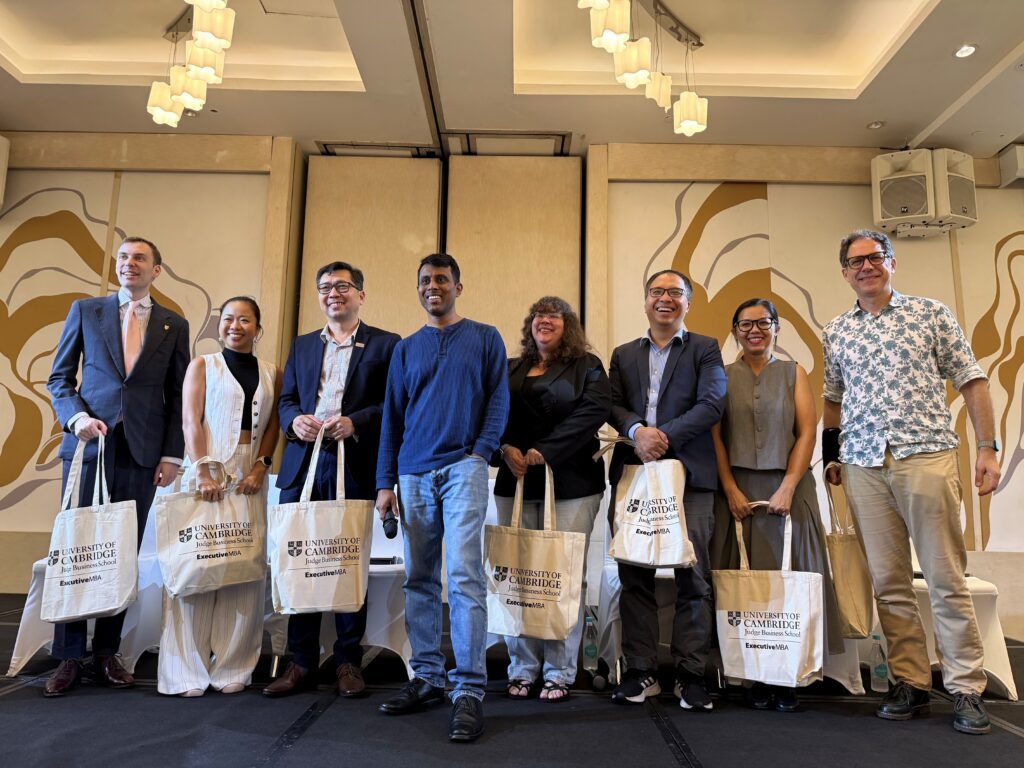
Innovation is not just in large companies. Ho Chi Minh City also has a thriving entrepreneurship community. We met 7 entrepreneurs developing prosthetic hands for middle-income markets (Vulcan Augmentics), keeping the farmer at the heart of the process in farm-to-café chocolates (Marou Chocolate), bringing AI to logistics (LogiVan) and customers worldwide (Nuao.io and Saigon AI) and building local infrastructure for sustainability (LoopNet and Greeviet). They remixed global and local solutions to address familiar challenges, such as supply chain provenance and health care affordability.
People and innovation challenge businesses worldwide, and it was great to see the Vietnamese twist. However, in our last experience, we learnt how sustainability can mean very different things to different cultures. We conducted field research in the markets, the malls and coffee shops around Ho Chi Minh City, led by fellow MBA students from HCMC University of Technology. Sustainability means faster and cheaper in Vietnam, a very different definition from the UK. Whilst initially surprising, this view primes the Vietnamese economy to embrace circularity since there is value to be gained, unlike in Europe, where sustainability is boxed into an ethical obligation. As a result, we saw a rise in importance of ecological sustainability among young people through customer-driven initiatives and educational posters encouraging children to think before using plastics and recycle what they did use. The Vietnamese view on sustainability also gives a different lens on the sustainability strategy presented at Sabeco earlier in the week, where one takeaway was that sustainability was simply good business as a strategy to reduce costs, as well as Laiday Refill, the entrepreneur driving a circular economy by matching businesses producing and utilising wastes.
While our time in Ho Chi Minh was short, the activities (both the academic and the less so) showed us that Vietnam today is a vibrant centre for creative problem solving, entrepreneurship in all its forms and global connection. And for those hastily rebooked journeys, the education continued with exploring the finer aspects of various locales and airports around Asia and some mild panic about jet fuel rationing reminding us that we are truly working in a global economy.
Thank you to Professors Michael Kitson and Christopher Marquis, as well as teaching assistant Lidia Mishchenko and Mo Tanweer, and to the Cambridge EMBA Programme Team, including Maria Prus, Isabel Halls and our EMBA25 ‘person’ Alistair Westwood, as well as their partners Bschool Travel. We are most grateful to our hosts in Vietnam: Intel Corporation, Sabeco and FPT Software, as well as Vulcan Augmentics, Marou Chocolate, LogiVan, LaiDay Refill Station, Nuao.io, Saigon AI and Greenviet. Finally, cảm ơn to our fellow students at HCMC University of Technology for their guidance, support and for showing us their city during our field research around Ho Chi Minh City.
Leave a Reply