

A blog post by Sunny Chen (Global Executive MBA 2025)

Introduction
When I first visited Bangkok in 2007, I was a tourist. I remember the food, the temples and the chaos of the traffic, but not much else. This time, I returned as a student. And that changed everything.
As part of the Global Executive MBA curriculum, the International Business Study Trip (IBST) is designed to help us understand how global strategy plays out in local contexts. Led by Professors Michael Kitson & Madeleine Rauch, the trip combined academic lectures, company visits, cultural immersion and group projects to explore how institutions, culture and market dynamics shape international business.
Thailand: more than tourism
Thailand is often known as a holiday destination, but it’s also a country that has quietly transformed itself. With nearly 70 million people and a GDP per capita of $7,345 in 2024, it has shifted from an agriculture-based economy to one that’s industrialised, export-driven and increasingly digital. Poverty has dropped dramatically, and the country now plays a strategic role in Southeast Asia’s growth story.
I left Bangkok with optimism. The country is evolving driven by ambition and innovation. Still, the question remains: can Thailand break free from the middle-income trap?

Business up-close
Our study trip gave us access to companies that shape Thailand’s economy. We visited CP Group, a homegrown giant with businesses in agriculture, retail, telecom and finance. ThaiBev, known for Chang Beer, showed us how local brands can expand across borders. Bosch and IBM gave us a glimpse into how global companies adapt to local markets. Each visit was a valuable lesson. We heard directly from leaders about how they navigate complexity, build teams and see opportunity in what others might call “mess”. This idea stuck with me.
Entrepreneurs and innovation
We also explored Bangkok’s innovation ecosystem through forums and founder panels. Doing business in Thailand requires agility, cultural fluency and a healthy respect for organised chaos. Entrepreneurs here don’t wait for perfect conditions. They build in the gaps. That spirit reminded me of Kamiar Mohaddes, Director of the Global EMBA Programme’s key message in June, when he said that innovation is less about novelty but more about “mindset, risk perception and community”.

GEMBA moments: learning, laughing, leading
Reconnecting with my GEMBA cohort in Bangkok brought a renewed sense of energy. From lectures on globalisation to unfiltered conversations during long traffic jams, we found ourselves learning just as much from each other as from the curriculum.
One of the academic highlights was our group project on institutional distance between Thailand and South Africa. My team developed a market entry strategy for a fictional solar power company, and I led the cultural analysis, examining how values, communication styles and expectations can shape business outcomes.
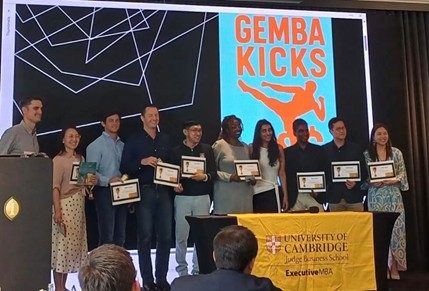
And, to wrap it all up, we hosted the GEMBA Kicks As$ Awards, a spontaneous, light-hearted ceremony that Nageen, Isobel and I pulled together. We handed out ten mock C-suite titles, each one inspired by the week’s lessons and inside jokes. It was our way of celebrating the legends, the jokers and the personalities that make GEMBA unforgettable.
Beyond Bangkok
Our learning didn’t stop in Bangkok. A few of us continued the journey to Hong Kong, where Kalvin Lau and I had the pleasure of hosting the group for the next chapter of learning. From the Hong Kong Stock Exchange to dim sum on the 103rd floor (yes, the view was stunning). We contrasted luxury with the humble authenticity of a famous noodle shop in Sham Shui Po. The owner’s story, teaching blind people to solve puzzle cubes and setting a world record, was a true inspiration.
We also recreated the Cambridge dinner experience, hosting the CEO of 6ixty8ight, who generously shared his insights on fast fashion supply chain management. In the end, it’s the learning, the laughter and, most importantly, the friendships that make these journeys unforgettable.
Final thoughts
I’ve enjoyed this study trip immensely. It was a special opportunity to understand a country from macroeconomic trends to the everyday realities of doing business on the ground. What stood out was how deeply people and culture shape the way business actually happens. I left with new ideas — some practical, some “dangerous” — about how I might stretch myself personally and professionally. 😊
“khàawp-khun khâ –Thank you for reading!!!”

Leave a Reply