

Nageen Qasim (Global Executive MBA 2025) highlights Eshita Kabra-Davies’ inspiring journey as CEO and founder of By Rotation. Speaking at the Leadership in Action Speaker Series, Eshita shared how she built a sustainable fashion tech venture while redefining purposeful leadership.
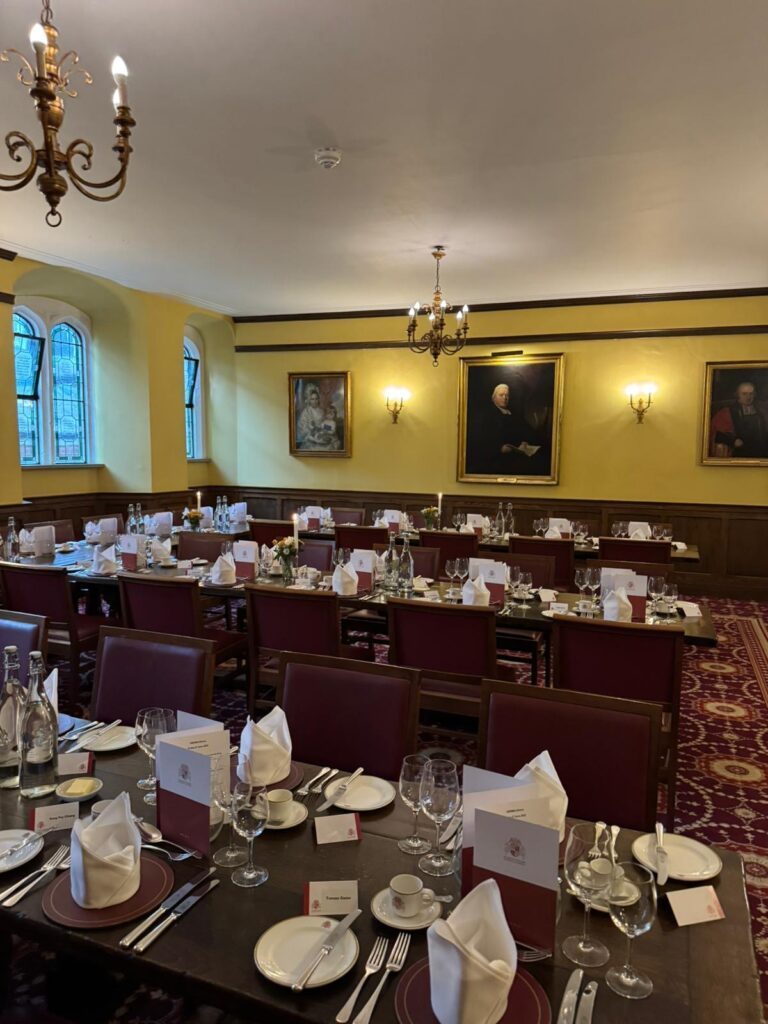
“You can’t be what you can’t see”. Few embody this principle as compellingly as Eshita Kabra-Davies, CEO and founder of By Rotation. Speaking to a cohort of Cambridge Executive MBA students at the historic St. John’s College in June as part of the programme’s Leadership in Action Speaker Series, Eshita’s keynote speech highlighted how visibility, or the lack thereof, shapes ambition, opportunity and perception. The Leadership in Action Speaker Series is a recurring speaker series that features prominently in the Executive MBA curriculum and focuses on the leadership journeys and experiences of senior executives (CEOs, CFOs, etc), serving as an important bridge between academic learning and practitioner insights.
Eshita began her keynote by asking the audience a simple yet profound question: “When you think of a tech CEO, who comes to mind?” The resounding answer was predominantly white, male and affluent.
Her response then quietly dismantled each of the points above by listing all the ways she did not fit the mould for a traditional tech CEO: she didn’t attend a prestigious school, she wasn’t wealthy, she was a person of colour and she lacked the elite connections many assume are prerequisites for founding a fashion tech venture. Early in her journey, an investor even attempted to box her in, advising her to “just focus on South Asian clothing.” Rather than conforming, Eshita leveraged her unique perspective and lived experiences to build something new.
Born in Rajasthan, India, and raised across Singapore, the US and the UK, Eshita is a self-proclaimed ‘third-culture kid’ but, long before she became a successful CEO, she was an enterprising teenager who was already running her business online selling “website layouts” on PayPal. While she initially pursued a career as an investment analyst, Eshita eventually returned to her creative roots by launching By Rotation in April 2019, making it the UK’s first peer-to-peer fashion rental app, designed to make sustainable fashion accessible. The marketplace platform now boasts over 400,000 users and has facilitated the sharing of more than £50 million worth of fashion items, including customers like Dame Helen Mirren and Ellie Goulding.
A focus on customer centricity has led to By Rotation’s continued growth and popularity, with customer feedback leading to the addition of new rental categories on the app, including the option to list South Asian clothing, home décor and dog accessories. Eshita spoke candidly about how customers who used the app consistently had been able to generate passive revenue to fund everything from their IVF journeys to putting down a deposit for their home. These stories are a testament to the stickiness of By Rotation’s business model and the appeal of its mission: to drive sustainability by democratising fashion.
According to Greenpeace, the fashion industry is the second-biggest consumer of water and contributes approximately 10% to global carbon emissions. By Rotation actively promotes the circular economy, encouraging users to rent and share clothing rather than purchase new items, reducing waste and extending the lifecycle of garments.
Eshita’s journey also highlights systemic challenges for women in entrepreneurship: less than 2% of global venture capital funding goes to female founders, with women of colour likely receiving an even smaller fraction. This stark disparity underscores the structural barriers that persist in tech and finance. By building a successful, visible platform with both digital and physical reach, Eshita not only challenges these norms but also provides a roadmap and inspiration for other underrepresented founders.
However, By Rotation is more than a business; it is a statement about who belongs in tech and fashion leadership. Eshita’s visibility as a South Asian woman navigating a predominantly male-dominated, racially homogenous and exclusive industry offers inspiration and validation for countless others who might otherwise feel unseen. That she delivered this message at a college that admitted women as undergraduates only four decades ago underscores both the progress made and the work still ahead. After an exciting Q&A session during which Eshita fielded questions ranging from scaling up marketplace platforms during challenging economic events such as Covid to the advice she would give to aspiring entrepreneurs, Eshita’s story is a testament to the power of breaking moulds, defying stereotypes and creating space for others to thrive; it’s a reminder that, more now than ever, representation matters.

Leave a Reply