

By Alina Semenenko (Executive MBA 2025)
When I signed up for Cambridge Ecosystem Week, I assumed I knew what the week would be about. Carbon emissions. ESG frameworks. Net-zero roadmaps. The language that has become so familiar in boardrooms and business school classrooms alike that it can start to feel almost automatic.
I was wrong, or at least, incomplete.
Yes, sustainability was everywhere. But by Wednesday I realised that almost every conversation we were having was really about something else: the messy, uncomfortable, thrilling problem of innovation. How do you build solutions to challenges that science hasn’t fully solved yet? How do you fund research when you can’t yet articulate what you’re researching? These questions came up again and again, across sectors I hadn’t expected to find them in.
That reframing – sustainability as an innovation problem, not just an environmental one – is what I’ve been turning over in my mind ever since.
The hardest funding question
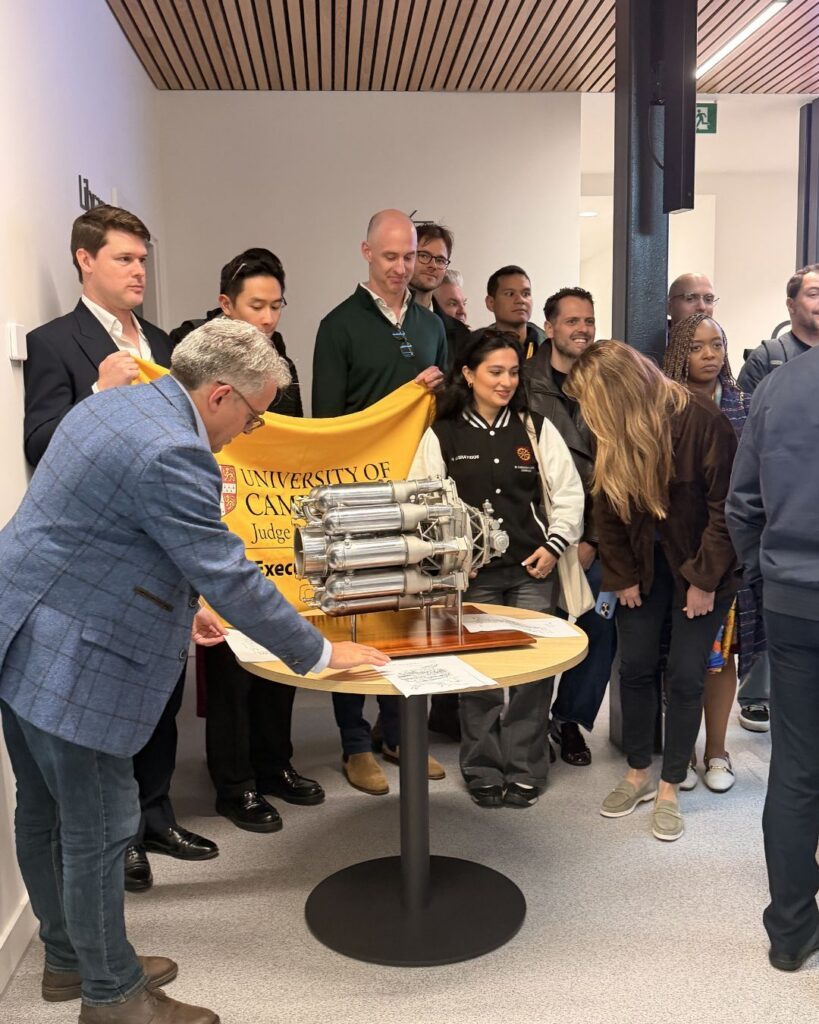
The session that unsettled me the most came from the Bennett Innovation Lab, an initiative modelling itself on the likes of Bell Labs and Google X: places built on the belief that some of the most important research can’t be justified on a spreadsheet, at least not yet.
Their mission centres on accelerating breakthrough technologies in energy, aviation and defence by combining frontier AI with rapid experimentation. But the question that lingered wasn’t about any specific technology. It was: how do you fund discovery before you know what you’re looking for?
Every investor I’ve encountered – and I suspect most people reading this – defaults to wanting evidence. Market sizes. Customer validation. Financial projections. That instinct is rational. But it systematically underweights the kind of early-stage, directionally uncertain work that has historically produced the most transformative results.
Google X’s well-publicised culture of celebrating failure isn’t just a quirky management philosophy. It’s a structural response to this problem. If you only reward success, you only get incremental bets. The Bennett Lab seems to operate with a similar logic, and I came away thinking we need more institutional willingness – in both the private and public sectors – to hold that tension between rigour and openness.
What AI might find that we can’t
This theme carried into conversations about advanced engineering and aviation, where researchers are using AI to model systems of staggering complexity – airflow dynamics, atmospheric turbulence, turbine behaviour under extreme pressure.
What struck me was a broader question sitting underneath all of it: could AI begin to surface patterns in the natural world that humans simply haven’t had the capacity to notice? Throughout history, scientific progress has been bounded by what we can observe and mentally hold at once. AI doesn’t have that constraint in the same way.
I don’t want to overstate this – there’s plenty of hype around AI to go around. But in the context of sustainability research specifically, where the datasets are enormous and the relationships between variables are poorly understood, the possibility feels genuinely significant. Some of tomorrow’s breakthroughs might not come from humans asking better questions. They might come from machines flagging answers to questions we hadn’t thought to ask.
Reinvention, not replacement
One of my more uncomfortable assumptions going into the week was about which organisations belong in the sustainability conversation. I had a vague mental model of old industries versus new ones – legacy players versus startups with cleaner balance sheets and cleaner missions.
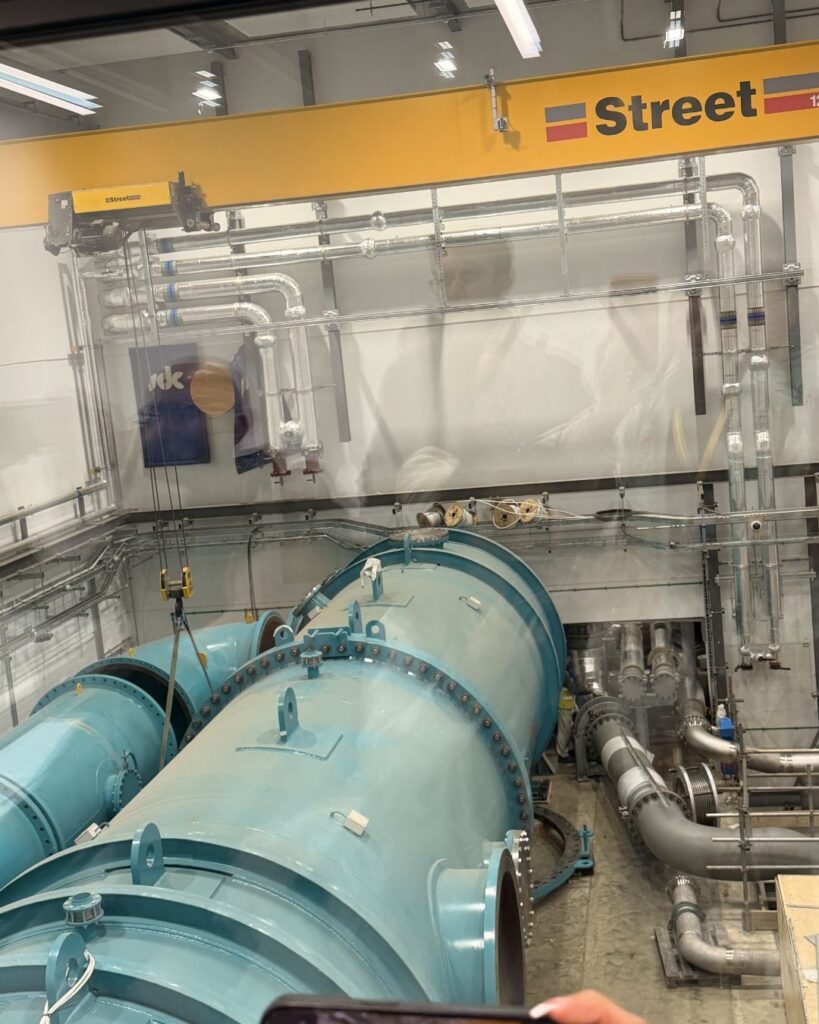
The visit to SLB (formerly Schlumberger), a company approaching its centenary and still widely associated with oilfield services, challenged that pretty directly. They’re investing seriously in geothermal energy, hydrogen and carbon capture.
The point isn’t that every incumbent is genuinely transforming, or that those transitions are without tension. AstraZeneca was refreshingly candid about this: sustainability commitments are real, but so are the pressures of growth, investment cycles and shareholder expectations. Navigating those trade-offs honestly is harder than putting out a net-zero pledge.
The more useful framing, I think, is that sustainability transitions need organisations with scale, engineering depth and global reach – and some of those organisations already exist. The challenge isn’t only about creating new companies. It’s about giving existing ones the conditions, the leadership and the cultural permission to evolve.
The infrastructure you never think about
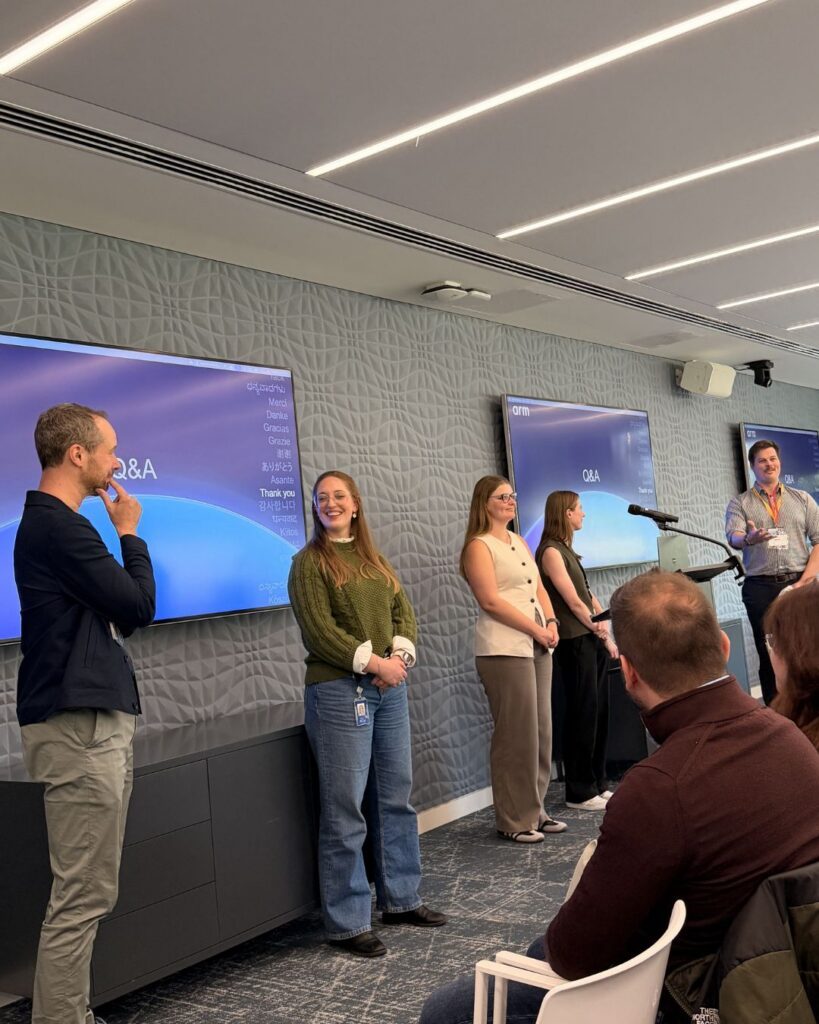
My favourite session of the week was probably the one with Paul Williamson from Arm, partly because it was about the company whose technology is almost certainly inside my phone, my laptop and half the devices in the room.
Arm’s insight – that the most transformative technologies become invisible precisely because they become foundational – feels important beyond semiconductors. Electricity. The internet. Cloud computing. We only notice them when they fail. That invisibility is actually a mark of success, but it also means their environmental implications go underexamined. Improvements in computing efficiency, deployed across billions of devices, can have enormous cumulative environmental impact. The numbers involved are almost hard to think about clearly.
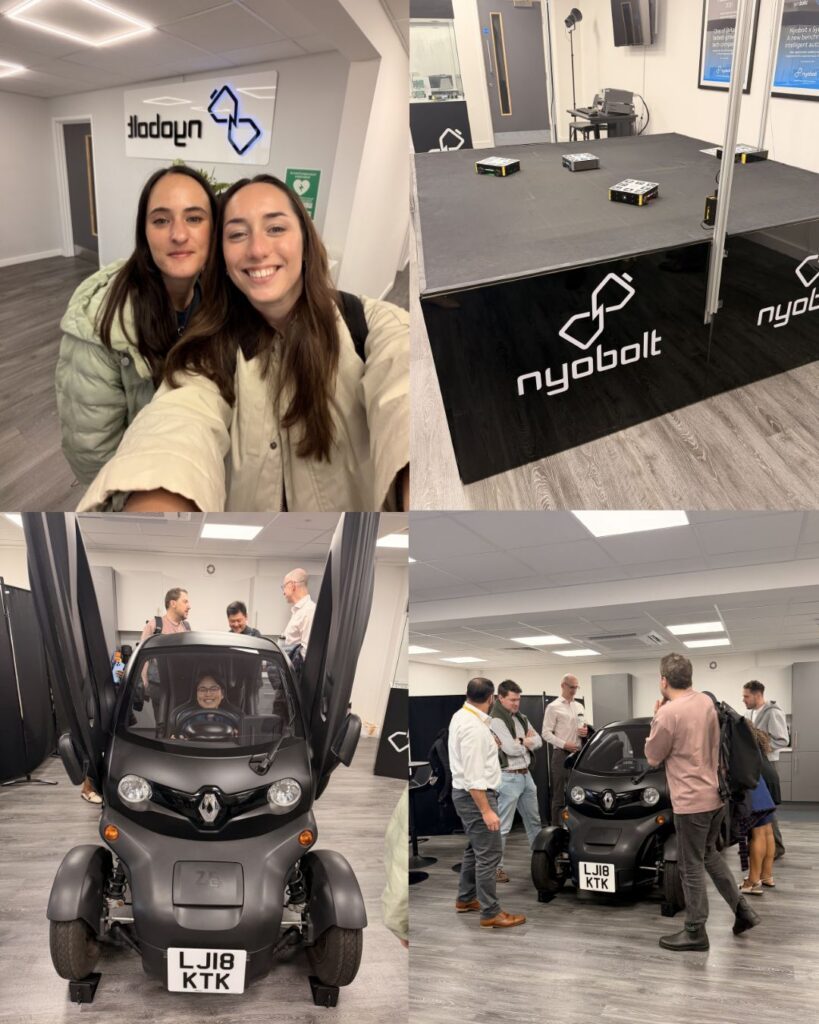
This connected naturally to the visit to Nyobolt, a Cambridge-based battery scale-up built on over a decade of research led by Professor Dame Clare Grey. The current conversation around AI tends to focus on models and algorithms, but AI runs on physical infrastructure – data centres, autonomous systems, electric vehicles – all of which require serious advances in energy storage. The future of AI might depend as much on what happens in battery chemistry as in software architecture. That’s not a framing I’d encountered before, and it’s one I keep coming back to.
Where science meets the rest of the world
What made the week richer than a corporate campus tour was the range of contexts we saw similar challenges play out in. Dr Beatrix Schlarb-Ridley from the British Antarctic Survey spoke about the gap between world-class research and real-world impact – how discovery creates value only when it gets translated into something that reaches people. Holding a piece of ice that formed 10,000 years ago while discussing climate science is, I’ll admit, an experience that cuts through in a way that a lecture slide doesn’t.
Tom Martin from Lloyds Banking Group made a point that also stayed with me: sustainability isn’t only an environmental story. Resilient financial systems and social trust are part of what a sustainable future looks like. It’s easy to forget that when the framing is always about emissions.
On leadership and uncertainty
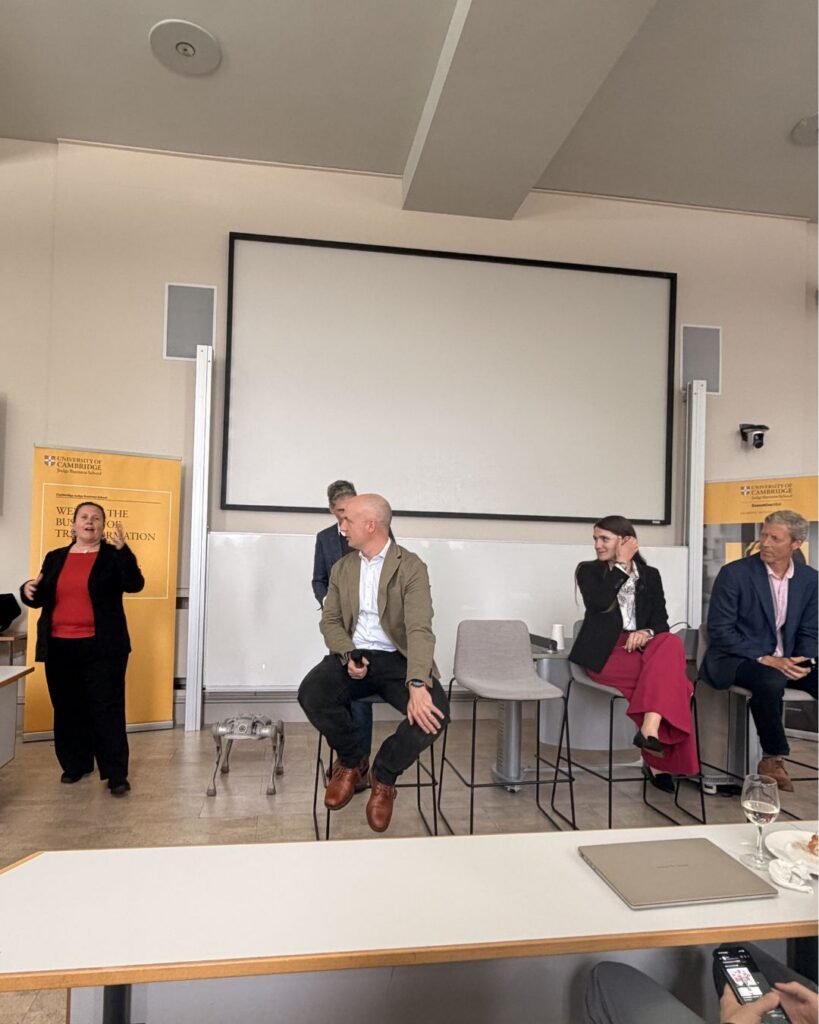
The personal story that resonated most came from Tom Grundy, CEO of Hybrid Air Vehicles and a Cambridge Executive MBA alumnus. His career has covered aerospace engineering, flight testing, defence and now lower-emission aviation. But what stood out wasn’t the technical biography. It was how consistently he returned to the idea of culture – specifically, the cultures that allow organisations to experiment, fail usefully and keep going.
We heard versions of this across the week. Technology matters. Strategy matters. But culture is what determines whether an organisation can actually move when the moment requires it. The ability to navigate genuine uncertainty – not managed uncertainty, but the real kind, where the answer isn’t available yet – strikes me as one of the defining leadership challenges of the next few decades. Business school teaches a lot of frameworks for decision-making under uncertainty, but what is even more important is to learn how to sit with it.
A different lens
I started the week thinking about sustainability in fairly conventional terms: emissions targets, ESG reporting, the energy transition. I ended it with a more tangled and, I think, more accurate picture.
Sustainability isn’t a standalone function or a compliance checklist. It’s a systems problem – and the systems involved are vast, interconnected and only partially understood. Climate change, energy security, healthcare, economic resilience, technological development: these things pull on each other in ways that make clean solutions rare and trade-offs inevitable.
What I found unexpectedly encouraging was the sheer variety of places where serious work is happening. A pharmaceutical company rethinking its supply chain. A semiconductor company chasing efficiency gains. A battery startup working on chemistry that most people have never heard of. A research institution preserving ice cores that contain information about the planet’s past. An innovation lab exploring ideas without knowing yet where they lead.
None of them will solve this alone. Progress will come from thousands of efforts moving simultaneously, often without coordination, occasionally colliding in productive ways.
What connected all the organisations we visited wasn’t a shared business model or a shared industry. It was a shared willingness to work on hard problems with incomplete information – and to keep going anyway.
That feels like the right disposition for what’s ahead.
Narayan BL
Excellent reflection, Alina.
As a participant in the Cambridge Judge Business School Chief Technology Officer Programme, my biggest takeaway is that sustainability is fundamentally an innovation challenge rather than a compliance challenge.
Whether we are discussing AI, energy, healthcare or climate resilience, the breakthrough organisations will be those capable of innovating under uncertainty, investing in long-term thinking and building cultures that support experimentation.
I was particularly interested in the observation that the future of AI may depend as much on advances in infrastructure, semiconductors, energy efficiency and battery technology as on software itself. We often focus on visible innovation while overlooking the foundational technologies that make transformation possible.
A powerful reminder that solving tomorrow’s challenges requires systems thinking, patient innovation and leadership willing to embrace uncertainty.
#Sustainability #Innovation #AI #TechnologyLeadership #CTO #DigitalTransformation #SystemsThinking #Leadership #FutureOfTechnology #CambridgeJudge